Although most religions contain assertions of universal equality,
religion poses the greatest challenge to the realization of human
rights, according to the author of Women’s Rights and Religious
Practice: Claims in Conflict.
In an address entitled “Religion and Human Rights: When are
Rights not Right?” the Rev. Alison Boden, an ordained minister in
the United Church of Christ, asserted that serious theological
engagement with human rights is necessary to resolve conflicting
human rights claims. She spoke in mid-April before the Program
on Religion, Diplomacy, and International Relations at Princeton
University where she serves as Dean of Religious Life.
Describing herself as “reflexively defensive” of human rights
discourse, she dismissed arguments that rights are “culturally
relative” and that the international human rights framework
represents Western “ethical imperialism” or “re-colonization.” She
said such ideas had their heyday in journals “a decade or two ago.”
Nonetheless, she said, an appeal to rights is not always the best way
to realize those very rights. Sometimes it requires direct
engagement with the theological content, interpretations, and ritual
practices of a given religion.
Citing practices such as female circumcision in Africa, the shunning
of widows in India, and opposition to same-sex marriage in the U.
S., Dr. Boden said religious freedom is often cited to counter claims
that such practices violate human rights.
She noted that human rights instruments, such as the Universal
Declaration of Human Rights and the numerous covenants that have
written many of its principles into international law, have been
deliberately crafted to “avoid appeals to religion” and other
categories with the intention of addressing a more basic human
essence.
All that is needed to have human rights, in the view of these
instruments, is to be a member of the human species, she said, but
she noted that religious traditions do not always concur that human
beings are ends in themselves.
Many traditions hold that humans are “reflections,”
“representations,” or “vessels” of the divine. Some traditions
understand rights as rewards that are earned through faithful
execution of duty, she said.
Although some argue that religious freedom should take precedence
over all other rights, Boden suggested that juxtaposing competing
rights claims is not as effective as examining the tradition for
evidence of values consistent with human rights principles.
As an example of what needs to be done, she cited the work of non-
governmental organizations in India, which are working with
groups of outcast widows to read the sacred texts of their tradition
with an eye to developing the capacity to challenge shunning. “All
religions have everything that is needed for human rights,” Boden
said.
Princeton’s Program on Religion, Diplomacy, and International
Relations is sponsored by the Lichtenstein Institute on Self-
Determination.
religion poses the greatest challenge to the realization of human
rights, according to the author of Women’s Rights and Religious
Practice: Claims in Conflict.
In an address entitled “Religion and Human Rights: When are
Rights not Right?” the Rev. Alison Boden, an ordained minister in
the United Church of Christ, asserted that serious theological
engagement with human rights is necessary to resolve conflicting
human rights claims. She spoke in mid-April before the Program
on Religion, Diplomacy, and International Relations at Princeton
University where she serves as Dean of Religious Life.
Describing herself as “reflexively defensive” of human rights
discourse, she dismissed arguments that rights are “culturally
relative” and that the international human rights framework
represents Western “ethical imperialism” or “re-colonization.” She
said such ideas had their heyday in journals “a decade or two ago.”
Nonetheless, she said, an appeal to rights is not always the best way
to realize those very rights. Sometimes it requires direct
engagement with the theological content, interpretations, and ritual
practices of a given religion.
Citing practices such as female circumcision in Africa, the shunning
of widows in India, and opposition to same-sex marriage in the U.
S., Dr. Boden said religious freedom is often cited to counter claims
that such practices violate human rights.
She noted that human rights instruments, such as the Universal
Declaration of Human Rights and the numerous covenants that have
written many of its principles into international law, have been
deliberately crafted to “avoid appeals to religion” and other
categories with the intention of addressing a more basic human
essence.
All that is needed to have human rights, in the view of these
instruments, is to be a member of the human species, she said, but
she noted that religious traditions do not always concur that human
beings are ends in themselves.
Many traditions hold that humans are “reflections,”
“representations,” or “vessels” of the divine. Some traditions
understand rights as rewards that are earned through faithful
execution of duty, she said.
Although some argue that religious freedom should take precedence
over all other rights, Boden suggested that juxtaposing competing
rights claims is not as effective as examining the tradition for
evidence of values consistent with human rights principles.
As an example of what needs to be done, she cited the work of non-
governmental organizations in India, which are working with
groups of outcast widows to read the sacred texts of their tradition
with an eye to developing the capacity to challenge shunning. “All
religions have everything that is needed for human rights,” Boden
said.
Princeton’s Program on Religion, Diplomacy, and International
Relations is sponsored by the Lichtenstein Institute on Self-
Determination.

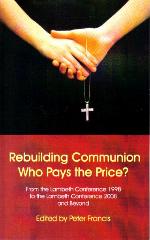
A book edited by the Rev. Peter Francis, warden of St. Deiniol’s
Library in Hawarden, Wales, has been released by Monad Press.
Rebuilding Communion: Who Pays the Price? features
contributions from Anglican leaders around the world, some of
whom presented at a recent conference at St. Deiniol's.
Video summaries of the conference presentations are available on
You Tube. Contributors include Simon Sarmiento (U.K.), editor of
Thinking Anglicans; Richard Kirker (U.K.), chief executive of the
Lesbian and Gay Christian Movement; Savitri Hensman, a native of
Sri Lanka who works in community care and writes on topics of
Christianity and social justice; Andrew Village (U.K.), senior
lecturer in practical and empirical theology at York St John
University.
Other contributors include Michael Hopkins (U.S.), former
president of Integrity; Davis Mac-Iyalla (Nigeria), president of
Changing Attitude, Nigeria; Donn Mitchell (U.S.), editor of The
Anglican Examiner, and Donald Reeves (U.K.), director of Soul of
Europe, a group working for reconciliation in Bosnia.
The book also includes chapters by Mario Ribas, a priest in the
Anglican Episcopal Church of Brazil; Muriel Porter, author and
member of the Standing Committee and Doctrine Commission of
the Australian General Synod; Michael Ingham, author and bishop
of the Canadian Diocese of New Westminster; Martyn Percy,
principal of Ripon College, Cuddesdon; and Edwin Arrison, a South
African Anglican priest and social entrepreneur.
St. Deiniol’s Library was founded in 1889 by Sir William Gladstone,
the churchman and Victorian era statesman.
Library in Hawarden, Wales, has been released by Monad Press.
Rebuilding Communion: Who Pays the Price? features
contributions from Anglican leaders around the world, some of
whom presented at a recent conference at St. Deiniol's.
Video summaries of the conference presentations are available on
You Tube. Contributors include Simon Sarmiento (U.K.), editor of
Thinking Anglicans; Richard Kirker (U.K.), chief executive of the
Lesbian and Gay Christian Movement; Savitri Hensman, a native of
Sri Lanka who works in community care and writes on topics of
Christianity and social justice; Andrew Village (U.K.), senior
lecturer in practical and empirical theology at York St John
University.
Other contributors include Michael Hopkins (U.S.), former
president of Integrity; Davis Mac-Iyalla (Nigeria), president of
Changing Attitude, Nigeria; Donn Mitchell (U.S.), editor of The
Anglican Examiner, and Donald Reeves (U.K.), director of Soul of
Europe, a group working for reconciliation in Bosnia.
The book also includes chapters by Mario Ribas, a priest in the
Anglican Episcopal Church of Brazil; Muriel Porter, author and
member of the Standing Committee and Doctrine Commission of
the Australian General Synod; Michael Ingham, author and bishop
of the Canadian Diocese of New Westminster; Martyn Percy,
principal of Ripon College, Cuddesdon; and Edwin Arrison, a South
African Anglican priest and social entrepreneur.
St. Deiniol’s Library was founded in 1889 by Sir William Gladstone,
the churchman and Victorian era statesman.

The Anglican Examiner |
Dogma Rarely the Cause of World's
Religious Conflicts, Expert Says
Religious Conflicts, Expert Says
| Illuminating Religion and Public Affairs Around the World |
What the news media describe as religious conflict in the world’s
trouble spots is rarely about doctrinal disagreements or questions of
faith. Instead, it is more likely to be competition for state power
divided along religious lines, according to David Smock of the
United States Institute of Peace, a Washington-based group
established and funded by the U.S. Congress to be an independent,
non-partisan peacemaking institution.
Smock addressed the Program on Religion, Diplomacy, and
International Relations at Princeton University in March. He noted
several examples of conflict where religion is a dimension of the
dispute, but the actual dispute is not about religion. The Arab-
Israeli conflict, for instance, is about land and self-determination.
Access to religious sites may be an issue, he said, and the parties
are divided along religious lines, but the dispute is not primarily
about the tenets of either Judaism or Islam.
In other cases, language and culture may be the overarching
division, even though the populations are also different religiously.
He cited the conflicts between the Walloons and Flemish in Belgium
and the French-speaking and English-speaking in Canada as
examples.
When religious identity overlaps the overtly contested differences,
the communications networks of the religious communities may be
used to mobilize the population. However, those same networks
can also be mechanisms for building peace, Smock said. He called
the exclusion of religious leaders from the Oslo peace process
which generated the Oslo Accords for resolution of the Israeli-
Palestinian conflict a mistake, saying religious leaders had told him
their exclusion had made it difficult for them to build support for
the Oslo Accords.
Smock, an ordained minister in the United Church of Christ, cited
interfaith dialogue as a critical component of peacemaking because
it can diffuse tensions and build trust. He referred the audience to
an on-line report entitled “What Works,” which evaluates the
effectiveness of various programs of interreligious dialogue.
trouble spots is rarely about doctrinal disagreements or questions of
faith. Instead, it is more likely to be competition for state power
divided along religious lines, according to David Smock of the
United States Institute of Peace, a Washington-based group
established and funded by the U.S. Congress to be an independent,
non-partisan peacemaking institution.
Smock addressed the Program on Religion, Diplomacy, and
International Relations at Princeton University in March. He noted
several examples of conflict where religion is a dimension of the
dispute, but the actual dispute is not about religion. The Arab-
Israeli conflict, for instance, is about land and self-determination.
Access to religious sites may be an issue, he said, and the parties
are divided along religious lines, but the dispute is not primarily
about the tenets of either Judaism or Islam.
In other cases, language and culture may be the overarching
division, even though the populations are also different religiously.
He cited the conflicts between the Walloons and Flemish in Belgium
and the French-speaking and English-speaking in Canada as
examples.
When religious identity overlaps the overtly contested differences,
the communications networks of the religious communities may be
used to mobilize the population. However, those same networks
can also be mechanisms for building peace, Smock said. He called
the exclusion of religious leaders from the Oslo peace process
which generated the Oslo Accords for resolution of the Israeli-
Palestinian conflict a mistake, saying religious leaders had told him
their exclusion had made it difficult for them to build support for
the Oslo Accords.
Smock, an ordained minister in the United Church of Christ, cited
interfaith dialogue as a critical component of peacemaking because
it can diffuse tensions and build trust. He referred the audience to
an on-line report entitled “What Works,” which evaluates the
effectiveness of various programs of interreligious dialogue.
Home Seeing Christ In Human Rights The New York Anglicans Careers in Theological Education Christian Witness in Investments Contact Us |
When Rights are Not Right:
Theology Key to Resolving Conflicting
Rights Claims, Author Says
Rights Claims, Author Says
Book Asks Who Pays the
Price to Rebuild Communion?
Price to Rebuild Communion?
| The Anglican Examiner Copyright by Donn Mitchell, 2010 |
Donn Mitchell's Lambeth Reflections
Of Apostles and Appeasement
Of Apostles and Appeasement
When I joined the church as a college freshman many years
ago, I imagined I would one day attend a General Convention and
eventually a Lambeth Conference. The first dream was fulfilled
in 1979 and repeated several times since.
So it was a believable—nonetheless thrilling—development
when the Lesbian and Gay Christian Movement in the United
Kingdom asked me to help develop a Lambeth exhibit celebrating
the 60th anniversary of the Universal Declaration of Human
Rights. It was the first time gay-affirmative ministries were
represented at Lambeth, owing to a change in British law, rather
than Canterbury’s heart, according to my colleagues there.
I returned from my first General Convention exhilarated at
having realized a dream but laden with a very heavy heart. Now,
almost 30 years later, I return from Lambeth in exactly the same
condition. In 1979, on the recommendation of a sexuality
commission which had no gay or lesbian-identified members,
Convention had resolved that ordaining people like me was
“inappropriate” at that time.
Life on the "Fringe"
This time around, it was not just the call for indefinite
moratoria that troubled me. It was the overarching climate of
exclusion. Even the bishops’ daily briefings were closed
proceedings that I, and most of my colleagues, could not attend.
There were restrictions on the type of food we could buy, and all
of our events were formally described in the conference program
as “Fringe Events.” Small wonder they were poorly attended.
Despite the troubled climate at my first General Convention,
which had 15,000 people in attendance, 5,000 turned out to hear
gay people testify at a public hearing. At Lambeth, with 3,000 in
attendance, only 75 people, mostly not bishops, attended the
“African Voices” panel to hear LGBT African Anglicans tell
stories more terrifying than anything we had reported 30 years
earlier.
At that 1979 convention, the Integrity Eucharist was a standing-
room-only affair. In 2008, the Inclusive Church Eucharist,
celebrated by Carlos Touché-Porter, the courageous primate of
Mexico, drew a mere 200 (again mostly not bishops), with plenty
of seats to spare.
Despite the extent to which the broader church public was
excluded from Lambeth, it was impossible to escape the
realization that something good was occurring in the “indaba”
groups. But it is precisely the very glowing reports we have
heard that give me pause about its effect on the American
bishops. Subjected to excoriation and threat-making for more
than a decade, I suspect they are suffering from something akin
to “battered spouse syndrome.”
Conduct Unbecoming an Apostle
I fear that, conditioned by now to expect harsh treatment from
their critics, the Americans were so relieved to have the
momentary respite of “indaba” that they are now prepared to do
just about anything to avoid provoking another round of battering.
In my view, far too many of them appear willing to embrace
the Archbishop of Canterbury’s suggestion that unity will require
the provinces to “surrender autonomy.” And I fully expect many
of them to encourage the next General Convention to endorse the
“covenant process,” continuing to deny that its principal
motivation is to punish and exclude.
In family systems theory, the term “people-pleasing” describes
behavior in which people do things they do not really believe in,
hoping it will keep the abuser at bay. In political terms, it is
called “appeasement.” I call it conduct unbecoming an Apostle.
It is unbecoming primarily because it is spiritually
impoverished. It pulls the well-intentioned off center and lures
them into the cesspool of megalomania. Believing themselves to
be more powerful than they actually are, their actions more
efficacious than they actually are, those who suffer from
megalomania rely on human gestures to accomplish the change
of heart that can only be wrought by God.
The antidote, happily, is readily available, but the cure takes a
long time. In short, the American bishops must come home.
They must come home to their spiritual centers, and they must
come home to their American sees.
They must shed the delusion that they are “bishops of the
world” and focus on being bishops to their American flocks, the
flocks through which God called them to the episcopate, the
flocks that populate the parishes, raise the diocesan budgets, and
underwrite their ministries.
And they must stop apologizing for American arrogance and
lift up the American heritage of religious freedom for the blessing
that it is.
Freedom as God's Gift
For more than two centuries, the U.S. Constitution has
guaranteed religious groups the right to worship as they see fit,
to define and interpret their beliefs according to their own
criteria, and to choose their lay and ordained leadership without
interference from the government, private citizens, or other
religious groups. These rights—now internationally recognized—
should be affirmed as gifts from God and not denigrated as
manifestations of American unilateralism.
These same rights are fragile or non-existent in many parts of
the Anglican Communion. Indeed, a number of bishops have
claimed that they face retaliation from hostile governments or
other religious groups in their countries based on their
participation in the Anglican Communion. For more than two
centuries, the Episcopal Church has been free of these kinds of
problems.
In the “rush to covenant” and to please their (mostly) brother
bishops, will American Episcopalians now import these problems
into American religious life by conceding authority over
ordination decisions to persons not bound by the constitution and
canons of the Episcopal Church and not schooled in the
constitutional traditions of religious freedom?
And what of people like me? I was 29 years old at my first
General Convention. When Lambeth meets again, I will be 68.
Will Anglicans be any more ready to honor Our Lord’s command
to love one another as he has loved us?
Fortunately, my hope and my help are in the Name of the Lord,
not the Anglican Communion.
ago, I imagined I would one day attend a General Convention and
eventually a Lambeth Conference. The first dream was fulfilled
in 1979 and repeated several times since.
So it was a believable—nonetheless thrilling—development
when the Lesbian and Gay Christian Movement in the United
Kingdom asked me to help develop a Lambeth exhibit celebrating
the 60th anniversary of the Universal Declaration of Human
Rights. It was the first time gay-affirmative ministries were
represented at Lambeth, owing to a change in British law, rather
than Canterbury’s heart, according to my colleagues there.
I returned from my first General Convention exhilarated at
having realized a dream but laden with a very heavy heart. Now,
almost 30 years later, I return from Lambeth in exactly the same
condition. In 1979, on the recommendation of a sexuality
commission which had no gay or lesbian-identified members,
Convention had resolved that ordaining people like me was
“inappropriate” at that time.
Life on the "Fringe"
This time around, it was not just the call for indefinite
moratoria that troubled me. It was the overarching climate of
exclusion. Even the bishops’ daily briefings were closed
proceedings that I, and most of my colleagues, could not attend.
There were restrictions on the type of food we could buy, and all
of our events were formally described in the conference program
as “Fringe Events.” Small wonder they were poorly attended.
Despite the troubled climate at my first General Convention,
which had 15,000 people in attendance, 5,000 turned out to hear
gay people testify at a public hearing. At Lambeth, with 3,000 in
attendance, only 75 people, mostly not bishops, attended the
“African Voices” panel to hear LGBT African Anglicans tell
stories more terrifying than anything we had reported 30 years
earlier.
At that 1979 convention, the Integrity Eucharist was a standing-
room-only affair. In 2008, the Inclusive Church Eucharist,
celebrated by Carlos Touché-Porter, the courageous primate of
Mexico, drew a mere 200 (again mostly not bishops), with plenty
of seats to spare.
Despite the extent to which the broader church public was
excluded from Lambeth, it was impossible to escape the
realization that something good was occurring in the “indaba”
groups. But it is precisely the very glowing reports we have
heard that give me pause about its effect on the American
bishops. Subjected to excoriation and threat-making for more
than a decade, I suspect they are suffering from something akin
to “battered spouse syndrome.”
Conduct Unbecoming an Apostle
I fear that, conditioned by now to expect harsh treatment from
their critics, the Americans were so relieved to have the
momentary respite of “indaba” that they are now prepared to do
just about anything to avoid provoking another round of battering.
In my view, far too many of them appear willing to embrace
the Archbishop of Canterbury’s suggestion that unity will require
the provinces to “surrender autonomy.” And I fully expect many
of them to encourage the next General Convention to endorse the
“covenant process,” continuing to deny that its principal
motivation is to punish and exclude.
In family systems theory, the term “people-pleasing” describes
behavior in which people do things they do not really believe in,
hoping it will keep the abuser at bay. In political terms, it is
called “appeasement.” I call it conduct unbecoming an Apostle.
It is unbecoming primarily because it is spiritually
impoverished. It pulls the well-intentioned off center and lures
them into the cesspool of megalomania. Believing themselves to
be more powerful than they actually are, their actions more
efficacious than they actually are, those who suffer from
megalomania rely on human gestures to accomplish the change
of heart that can only be wrought by God.
The antidote, happily, is readily available, but the cure takes a
long time. In short, the American bishops must come home.
They must come home to their spiritual centers, and they must
come home to their American sees.
They must shed the delusion that they are “bishops of the
world” and focus on being bishops to their American flocks, the
flocks through which God called them to the episcopate, the
flocks that populate the parishes, raise the diocesan budgets, and
underwrite their ministries.
And they must stop apologizing for American arrogance and
lift up the American heritage of religious freedom for the blessing
that it is.
Freedom as God's Gift
For more than two centuries, the U.S. Constitution has
guaranteed religious groups the right to worship as they see fit,
to define and interpret their beliefs according to their own
criteria, and to choose their lay and ordained leadership without
interference from the government, private citizens, or other
religious groups. These rights—now internationally recognized—
should be affirmed as gifts from God and not denigrated as
manifestations of American unilateralism.
These same rights are fragile or non-existent in many parts of
the Anglican Communion. Indeed, a number of bishops have
claimed that they face retaliation from hostile governments or
other religious groups in their countries based on their
participation in the Anglican Communion. For more than two
centuries, the Episcopal Church has been free of these kinds of
problems.
In the “rush to covenant” and to please their (mostly) brother
bishops, will American Episcopalians now import these problems
into American religious life by conceding authority over
ordination decisions to persons not bound by the constitution and
canons of the Episcopal Church and not schooled in the
constitutional traditions of religious freedom?
And what of people like me? I was 29 years old at my first
General Convention. When Lambeth meets again, I will be 68.
Will Anglicans be any more ready to honor Our Lord’s command
to love one another as he has loved us?
Fortunately, my hope and my help are in the Name of the Lord,
not the Anglican Communion.
In the final draft text of the proposed Anglican Communion
Covenant, even the Church of England “by law established”
could be “suspended” if a Standing Committee of the Anglican
Consultative Council and the Primates’ Meeting deems a
particular action “incompatible” with the covenant.
While devoting the bulk of its text to affirmations of diversity,
plurality, and provincial autonomy, the final text of the proposed
covenant still creates a disciplinary mechanism that will give an
elite group unprecedented power to sanction, discipline, and
exclude member churches for taking actions (or making
prophetic witness) deemed “controversial” by people who object
to such actions or witness.
Section 4.2.5 allows the Standing Committee to request a church
to defer a controversial action or face “relational consequences.”
The Standing Committee can deem an action “controversial”
regardless of how much support it has in the “offending”
church, even if failing to take the action would violate local
canon or civil law.
No provision is made for determining whether the views of
primates, councilors, and standing committee members
accurately represent the consensus fidelium in their own
provinces, which range in size from 12,000 to 25,000,000
baptized. Read the complete draft text here.
Covenant, even the Church of England “by law established”
could be “suspended” if a Standing Committee of the Anglican
Consultative Council and the Primates’ Meeting deems a
particular action “incompatible” with the covenant.
While devoting the bulk of its text to affirmations of diversity,
plurality, and provincial autonomy, the final text of the proposed
covenant still creates a disciplinary mechanism that will give an
elite group unprecedented power to sanction, discipline, and
exclude member churches for taking actions (or making
prophetic witness) deemed “controversial” by people who object
to such actions or witness.
Section 4.2.5 allows the Standing Committee to request a church
to defer a controversial action or face “relational consequences.”
The Standing Committee can deem an action “controversial”
regardless of how much support it has in the “offending”
church, even if failing to take the action would violate local
canon or civil law.
No provision is made for determining whether the views of
primates, councilors, and standing committee members
accurately represent the consensus fidelium in their own
provinces, which range in size from 12,000 to 25,000,000
baptized. Read the complete draft text here.
Final Draft of Covenant
Text Still a 'Power Grab'
Text Still a 'Power Grab'