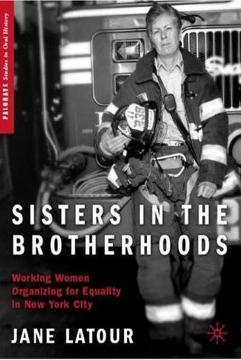

| By Jane LaTour |

| Sisters in the Brotherhoods |
| Photo by Jon Bloom |
| Every purchase via this website supports human rights work. Learn more. |
| What's Inside? |
| Firefighter |
| As the lead named plaintiff in the class action lawsuit—Berkman v. Koch—that opened up the doors of the firehouses to women, her career was constantly shadowed by the perceptions about her created in those early days. Throughout her 24 years in the department, Brenda Berkman was a “lighting rod” for all of the emotions that swirled around the subject of female firefighters in New York City. As far along in her career as 1993, the Fire Department New York (FDNY) was still issuing orders about Berkman: That no photos could be taken of her— either on or off duty—inside or outside of a firehouse. After being promoted to lieutenant in 1995, her superior officer paid her a visit at Ladder 12. As she recalled, “The Captain was not particularly happy to have me come there . . . A lot of it just had to do with reputation versus reality. The saying in the Fire Department being: ‘Telephone, telegraph, tell a firefighter.’ There’s this very speedy and often inaccurate network of rumors that get spread about people. Not just about me, but definitely about me . . . The main thing that has improved our relationship is just getting to know one another. He realized that a lot of the rumors about me were inaccurate—that I’m a hard worker; that I’m conscientious and I’m trying to do the best that I can—that I’m not looking to cause problems in the firehouse; that I don’t have a thin skin. I have a good sense of humor. So these sorts of things allayed a lot of the initial concerns he had about me coming there.” In 2004, Berkman found it “hysterical”—her word for funny—that there were still men who wouldn’t take a seat next to her at union meetings. Even then, Steve Cassidy, the head of the United Firefighters Association (UFA), the union that fought so hard to keep the women out, couldn’t interact with her. “Every time I see [Steve] Cassidy, he won’t talk to me. He won’t look at me,” she said. “As far as I know, he’s never met with the women firefighters’ organization [United Women Firefighters].” |
| In 1982, even before Probationary Firefighter Brenda Berkman’s arrival at her first assignment, firefighters had already formed opinions about her. “It was impossible for me to keep a low profile,” she said. “Everybody knew my name. I had been getting death threats. I had to get an unlisted number . . . My picture had been in the paper. Everyone knew that I was a lawyer. So that gave them another reason to dislike me. They thought I was Jewish, so that was another reason—another unacceptable group—plus I wasn’t from New York.” |
| Brenda Berkman |